
Blockchain interoperability is the ability of separate blockchain networks to exchange messages, data and tokens with each other. If your token, app or tokenized asset has to work on more than one network, it is a design decision you make before launch, not a feature you bolt on later. We build blockchain and Web3 products and help them find users after launch, so this guide is written for the people who have to decide: founders, fintech teams, asset owners, lawyers advising crypto clients and companies entering blockchain for the first time. It keeps the jargon low and the trade-offs clear.
TL;DR
- Blockchains cannot talk to each other on their own. Interoperability is the extra layer that lets them pass data, tokens and instructions across.
- The main approaches are bridges, relays, atomic swaps, shared messaging protocols and application-specific chains. Each trades speed, cost and security differently.
- Bridges are the most attacked category in decentralized finance, with roughly USD 3 billion lost to bridge hacks, so security review is part of the design.
- Choose by scoring your use case on what the connection must do, how well it fits your systems and how it performs, not by picking the most popular tool.
- Plan the connection before you build the token or app, and have it audited before public launch.
Table of Contents
- What blockchain interoperability means
- Why your business may need it
- The five layers of interoperability
- The main approaches, compared
- Security: where cross-chain projects get hurt
- How to choose a solution
- Planning cross-chain features in a product build
- Work with a team that builds and grows the product
- FAQ
- Sources
What blockchain interoperability means
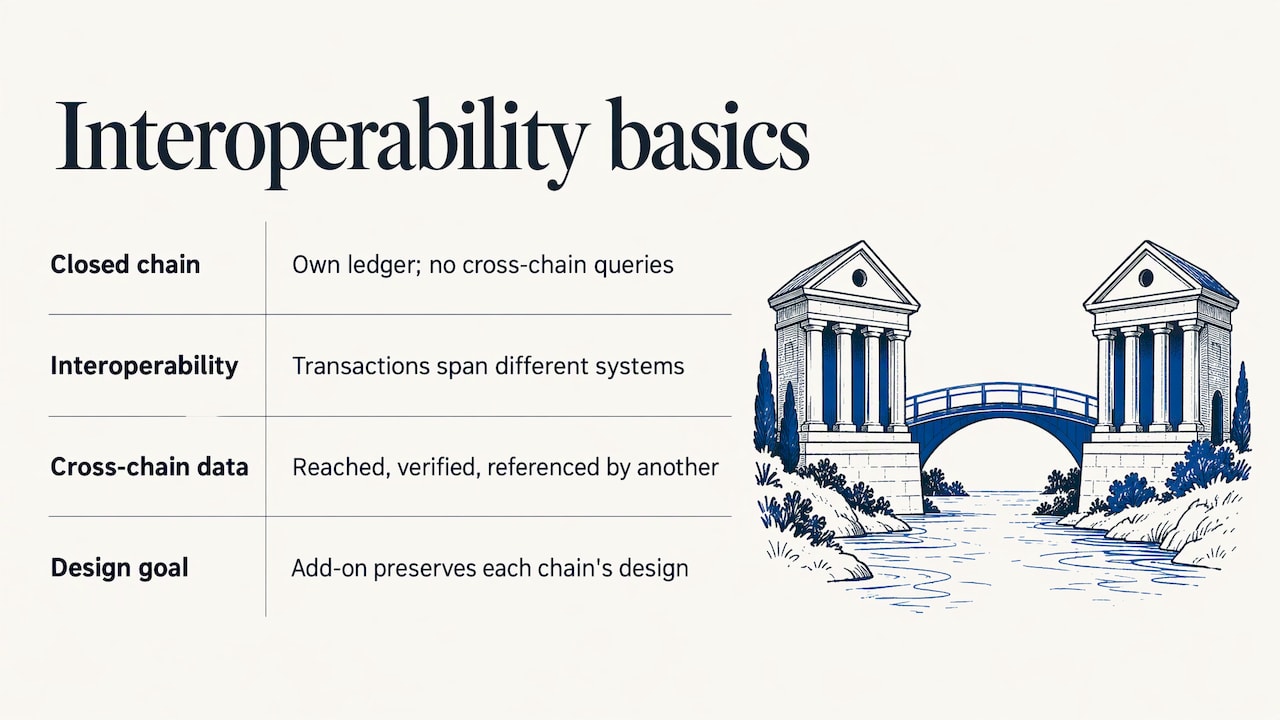
Every blockchain is a closed system. It keeps its own ledger, follows its own rules and has no built-in way to ask another chain a question. The Chainlink research summary is not needed to see the point: a chain simply cannot check, by itself, whether something happened on a different chain.
Interoperability fills that gap. A formal definition used in academic work, drawn from a US standards agency (NIST) draft, describes an interoperable architecture as one where a transaction can span several different blockchain systems, and where data recorded on one chain can be reached, verified and referenced by another in a compatible way, as described in a 2023 systematic survey in ACM Computing Surveys.
The same survey makes a point that matters for planning: interoperability should be an add-on that does not undermine the design of each chain it connects. It also notes that checking information from another chain without a trusted middleman is hard, and that no efficient method exists to fully copy one chain’s state onto another. Every solution you see is a compromise around those two facts.
In plain terms, you can think of chains as banks in different countries that use different currencies, languages and compliance rules. Interoperability is the correspondent network that lets money and messages move between them without anyone rewriting the other bank’s rulebook.
Why your business may need it
The European Union’s Blockchain Observatory and Forum, in its 2023 report on interoperability, says interoperability lets users move data and assets quickly, adds flexibility and links a fragmented ecosystem. It also argues that without it the market could drift toward a new kind of centralization, where a few ecosystems dominate. Its example is a logistics company on one blockchain validating transactions with a financial institution on another.
For our readers, that turns into concrete situations:
- Token launches. Your holders may sit on different networks. If the token lives on one chain only, you limit who can buy, trade or use it.
- Fintech integration. A payments or lending product may need to settle on one network while reading data from another.
- Asset tokenization. An owner issuing tokens for real estate, funds or commodities may want investors and trading venues on several chains.
- Enterprise projects. A company running a private network often needs it to exchange records with a public chain or a partner’s system.
- Legal and compliance work. Lawyers advising crypto clients need to know which chain holds which record, because a transfer across chains creates more than one set of records and potentially more than one point of control.
If you are only building a single-network product with no plans to expand, you may not need any of this yet. Most funded teams discover they do within a year of launch, which is why we ask about it at the start of a project.
The five layers of interoperability
A useful way to see where problems arise is to split a cross-chain system into layers. A 2023 ACM survey on cross-chain technologies describes five:
- Network layer. How nodes talk to each other, and how messages travel between chains.
- Data layer. How data is formatted and proven, so that another chain can recognize it as real.
- Consensus layer. The rules for agreeing that something is final, and how trust is built, either by checking proofs or by relying on one or several trusted parties.
- Incentive layer. The rewards and penalties for the people or programs that carry messages across.
- Application layer. What users actually do: transfer assets, swap them, share data or run a smart contract that spans chains.
When you talk with a development team, ask which of these layers each tool covers. Many products only handle the network and data layers and leave the application logic to you. That gap is where schedules slip and bugs appear.
The main approaches, compared
There is no single method. The European report groups solutions into public connectors (sidechains, chain relays and notary schemes), atomic swap protocols with cross-chain trading pools, and application-specific blockchains. Other sources add shared messaging protocols and the Cosmos-style IBC standard. Here is a plain comparison.
| Approach | How it works in plain terms | Strength | Watch out for |
|---|---|---|---|
| Sidechain | Assets are locked on the main chain and matching funds are created on a second chain | Easy to build, can take load off the main chain | Adds complexity and new attack points, and still relies on trust |
| Notary or multi-signature bridge | A group of signers confirms that something happened on one chain | Fast and cheap | You trust the signers and their key security |
| Chain relay | A program on one chain checks the other chain’s block headers, passed along by off-chain helpers | Partly decentralized, can support atomic outcomes | Costly, no transaction privacy, exposed to front-running |
| Atomic swap | Two parties trade across chains, and either both sides happen or neither does | No middleman | Suits trading pairs, not general messaging |
| Messaging protocol | A contract on the source chain packages a message, a contract on the destination decodes and runs it | Flexible, supports data and value | Security depends on the verifier network you choose |
| IBC | Each chain checks the other’s state directly with an on-chain light client | No third-party intermediary | Works best between chains built for it |
The sidechain and relay descriptions come from the European report and a 2025 survey on cross-chain interoperability. Atomic swaps are defined in a survey of crosschain protocols as trades where state updates are either committed on all chains or discarded on all.
The IBC documentation states that the protocol connects more than 115 public networks and has processed over USD 50 billion in volume in more than five years of production without an exploit of the supported version. That is a strong record, though it applies to chains that implement the standard, and it is the project’s own reporting.
The trade-off every design faces
A 2024 paper in Communications of the ACM describes an industry view called the interoperability trilemma. A bridge wants to be trustless (its security tied to the source chain), extensible (easy to extend to new chains) and general (able to move both data and assets). Getting all three at once is hard, and latency, cost and security pull against each other.
The same paper reports two trends worth knowing. First, builders are stacking designs: a general messaging layer at the bottom, with token transfer and cross-chain trading built above it. Second, teams pick the security model to fit the use case. Speed- and cost-sensitive uses can accept a multi-signature design, while security-first uses lean on optimistic models or cryptographic proofs.
Security: where cross-chain projects get hurt
This is the part founders and lawyers most need to understand, because losses here are public and large.
The Communications of the ACM paper reports that, as of December 2023, more than 110 bridges held almost USD 18 billion in combined value, while about USD 3 billion had been lost to bridge hacks, making bridges the most attacked kind of decentralized finance application. A 2024 academic study of bridge security puts losses near USD 3.1 billion and finds that 65.8% of stolen funds came from projects secured by an intermediary network of approved signers with poorly protected keys. It catalogs 45 cross-chain vulnerabilities and 25 theoretical attacks.
Another 2024 study of 60 bridges and 34 exploits from 2021 to 2023 links 13 design components to eight kinds of weakness, including leaked private keys, bypassed authentication and replayed messages. Its suggested protections include strong multi-signature schemes kept isolated from each other, regular key rotation and zero-knowledge proofs for watchers that spot fraud.
The ACM cross-chain survey also lists open problems: chain reorganizations that undermine fairness and atomicity on many public chains, privacy leaks, efficiency and low throughput.
What this means in practice:
- Count the keys. Ask who or what can approve a transfer, and how those keys are stored and rotated.
- Limit what sits in the bridge. The European report recommends specialized bridges to keep risk small, plus smart contract audits and a full platform audit before public launch.
- Audit before you go live. Our blockchain security audit and smart contract audit services cover this step.
- Plan for failure. Decide in advance how you will pause transfers and communicate with users if something looks wrong.
How to choose a solution
Researchers have tried to make the choice less guesswork. Belchior and colleagues propose a 0 to 10 score called the Interoperability Assessment, or INAS, with three parts:
- Potentiality (0 to 4): can the system already work across the networks and protocols you need, as it stands?
- Compatibility (0 to 3): does it fit at the meaning level, the organizational level and the legal level?
- Performance (0 to 3): how do delay, throughput, cost and energy use look across chains?
The same group argues in Communications of the ACM that trust should be seen as a spectrum, not a yes or no, because these systems are complex and their threats keep changing. Treat any rating as a snapshot.
A simple worksheet for your team:
- Write down what must cross. Tokens only, data only, or instructions that trigger actions on the other side?
- Rank your priorities. Speed, cost and security rarely all win. Large transfers usually justify slower, stronger checks. Small, frequent ones may accept faster, lighter checks.
- List the chains and their differences. Note the execution environment, token standards and how quickly each chain treats a transaction as final.
- Map the legal side. Decide who controls assets at each step, which record is the official one and what happens in a dispute. This is where a lawyer’s questions and an engineer’s design need to meet early.
- Test the exit. Know how a user gets funds back if the connection stops working.
A common outcome for a first project is not to build a bridge at all. Many teams are better served by connecting through an established messaging layer and focusing their effort on the product. We help clients make that call as part of platform planning; our guide to blockchain platform development covers the wider decisions.
Planning cross-chain features in a product build
Interoperability touches several parts of a build, so it helps to place it in the plan:
- Token design. Decide early which networks your token will live on and in what form. A token that exists on several chains needs a clear rule for the official supply.
- Smart contracts. Contracts that send or receive cross-chain messages need extra checks, because they act on information from outside their own chain. Our overview of smart contracts in blockchain development explains the basics.
- Apps. A decentralized app that serves users on several chains needs one clear experience on top. See our dApp development page.
- Data sharing. For enterprise uses, the question is often what gets shared and with whom. Our article on how blockchain changes data sharing is a good companion.
- Testing and monitoring. Cross-chain flows fail in ways single-chain apps do not, such as a message arriving late or twice. Test those cases before launch.
Our view
Most teams treat interoperability as a technical checkbox. We see it as a business decision with a technical side. The chains you connect to decide who can find you, who can trade your token and where your liquidity sits.
That is why we work on the product and the audience together. A cross-chain feature that nobody uses is wasted money, and a popular one with weak security is a bigger problem. Our approach is to design the technology and the community and user growth around it as one plan, so a client is not left alone after launch.
Our advice is to connect fewer chains, and connect them well. Start with the networks where your users already are, have the design reviewed and audited, and grow from there. Plans that reach for every chain on day one tend to spread security attention thin.
Alok
Work with a team that builds and grows the product
Quest Global Technologies builds blockchain and Web3 products for crypto and fintech startups, funded projects, asset owners and enterprises, and has delivered over 300 projects globally. Beyond the build, we run community engagement and user acquisition so that a product reaches real users after launch. Our published starting points are from $3,000 one-off for white-label products and from $25,000 one-off for custom blockchain builds; other services, including blockchain consulting, are quoted per project.

If you are planning a token, exchange, tokenization project or app that needs to work across networks, start from our main services page or talk to us about hiring blockchain developers. We do not promise outcomes, but we do promise a clear plan and honest scoping.
FAQ
What is the difference between a bridge and interoperability?
Interoperability is the goal: networks working together. A bridge is one tool for reaching it, usually by locking assets on one chain and issuing matching ones on another. Other tools include relays, atomic swaps and messaging protocols.
Do I need interoperability for my token launch?
If your token will live on a single network and your users are there, not at launch. If you want holders and trading venues on several networks, plan for it from the start, because token design and contract choices are hard to change later.
Are cross-chain bridges safe?
Safety varies by design. Research shows bridges have been the most attacked category in decentralized finance, with losses around USD 3 billion, often tied to weak key protection. A well-reviewed design, limited funds in the bridge and an independent audit before launch lower the risk.
What are the biggest challenges of blockchain interoperability?
Verifying another chain’s information without trusting a middleman, keeping security strong while staying fast and cheap, protecting privacy across chains, and handling differences in how chains work and when they consider a transaction final.
How long does it take to add cross-chain features?
It depends on the approach and the chains involved, so we scope it per project. Using an established messaging layer is usually quicker than building a custom connection, and an audit should be planned before public launch either way.
Sources
- What Is Blockchain Interoperability? (Chainlink education hub)
- Exploring Blockchains Interoperability: A Systematic Survey, ACM Computing Surveys
- The current state of interoperability between blockchain networks, EU Blockchain Observatory and Forum
- A Survey on Cross-chain Technologies, ACM
- Enhancing Blockchain Cross Chain Interoperability, arXiv
- Survey of Crosschain Communications Protocols, arXiv
- What is IBC?, IBC Protocol documentation
- A Brief History of Blockchain Interoperability, Communications of the ACM
- SoK: Security and Privacy of Blockchain Interoperability, TechRxiv
- SoK: Cross-Chain Bridging Architectural Design Flaws, arXiv
- Do You Need a Distributed Ledger Technology Interoperability Solution?, ACM