
Blockchain marketing services are the community building, education, content, outreach and measurement work that helps a crypto or Web3 product earn trust and real users. The strongest results come when marketing and engineering are planned together, because what your team can ship and support decides what you can honestly promise. That is how we run it at Quest Global Technologies: we build the product and handle community engagement and user acquisition, so you are not left alone after launch.
This guide is for crypto startups launching tokens, fintech companies adding blockchain, asset owners exploring tokenization, and legal advisors who work with crypto clients. It explains what you are buying, what to ask for, and how to tell whether it is working.
TL;DR
- Blockchain marketing is mostly trust work: education, community and clear risk language come before ad reach.
- Rules change by country, and some ad channels can close with little notice, so compliance belongs in the plan from day one.
- Marketing claims must match what the product actually does, which is why technical support and marketing work best as one plan.
- Judge results by community quality, active users and retention, not impressions or follower counts.
- We combine product development with community growth and user acquisition. Our white-label products start from $3,000 one-off and custom blockchain builds from $25,000 one-off.
Table of Contents
- What blockchain marketing services actually are
- Why it differs from ordinary marketing
- What a full-service engagement should cover
- How priorities change by project type
- Where technical support fits in
- Rules you need to plan around
- A note on AI in your marketing
- How to measure whether it is working
- How to choose a provider
- Perspective
- Work with Quest GLT
- FAQ
- Sources
What blockchain marketing services actually are
The phrase covers two different things, and agencies often blur them.
The first is marketing a crypto or Web3 company: getting a token, exchange, wallet or fintech product in front of the right people using content, public relations, community management and campaigns. This is what most founders mean when they search for these services.
The second is using blockchain features inside marketing itself. Researchers define cryptomarketing as building crypto-native elements such as tokens, NFTs and smart contracts into marketing activity to drive engagement and community-based brand development. That is different from promoting a crypto company with conventional tools.
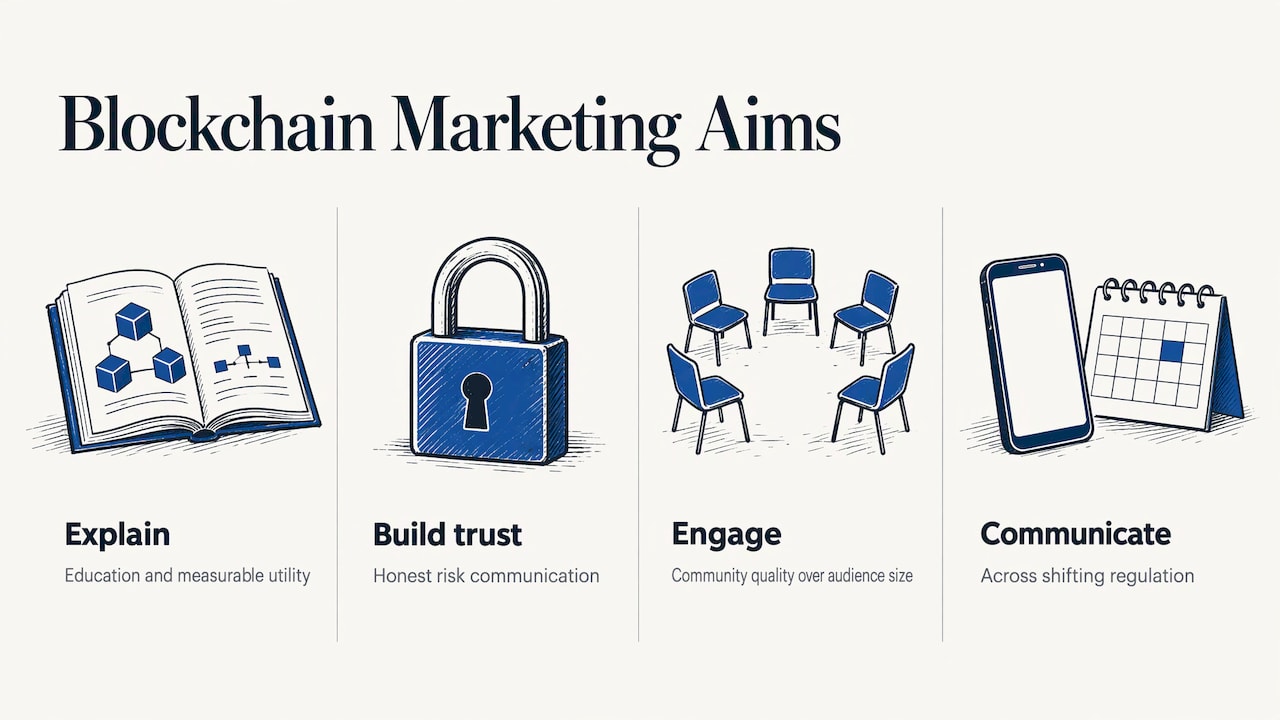
For most teams, the first meaning is the starting point. A market research overview describes the work as explaining distributed-ledger products, building trust with technical and nontechnical audiences, supporting community engagement and managing communications across shifting regulation. It also notes a move away from speculative promotion toward education, measurable utility and honest risk communication, with community quality mattering more than raw audience size.
If you want a plain-language grounding in the technology you will be explaining to customers, a primer on blockchain infrastructure basics is a good place to start.
Why it differs from ordinary marketing
Three differences shape every plan, according to a TechTimes analysis:
- You start with a trust deficit. Scams and rug pulls (projects that take investor money and disappear) mean a new project begins with a weaker reputation than a typical software launch.
- Trust comes before visibility. Community and credibility work has to run ahead of paid reach.
- Channels can vanish. Regulation can remove entire ad channels. The same analysis points to Meta’s January 2018 ban on cryptocurrency ads and Singapore’s ban on crypto advertising as examples.
In practice this means a plan built around one ad platform is fragile. A plan built around owned channels, a real community and clear educational content survives policy changes.
What a full-service engagement should cover
Whatever you call it, a complete engagement moves through three phases. Use this as a checklist when you compare proposals.
Before launch
- Positioning and messaging. One plain sentence on who the product is for and what problem it solves, with no jargon the buyer would need a glossary to follow.
- Educational content. Explainers, documentation, a website that answers the first ten questions a skeptical visitor will have.
- Community groundwork. Chat and social channels set up with moderation rules, so the first members meet an organized, responsive space.
- Compliance review. Claims, disclosures and target countries checked before anything is published.
At launch
- Announcement and outreach. Coordinated content, partner and media outreach, and community events.
- User acquisition. Campaigns aimed at people likely to actually use the product, not only hold a token for a day.
- Support readiness. Someone able to answer wallet, onboarding and transaction questions quickly, because launch week is when confusion peaks.
After launch
- Community management that keeps conversations useful as the first wave of attention fades.
- Ongoing content and education tied to product releases.
- Reporting on the numbers that show whether people are using the product.
Our own take on planning this sequence is laid out in our blockchain marketing strategy guide.
How priorities change by project type
The same service list gets weighted very differently depending on what you are launching.
| Project type | What the audience needs to see | Marketing weight |
|---|---|---|
| Token launch | What the token does, how it is distributed, who is behind it | Community, education, clear risk language |
| Fintech blockchain integration | Faster or cheaper settlement, fewer steps, familiar controls | Customer education, partner and B2B outreach |
| Asset tokenization | How ownership is recorded and what investors can and cannot do | Investor communication, legal clarity, trust signals |
| Established Web3 product | Reasons to stay, new features, active governance | Retention, community programs, release communication |
A token launch lives or dies on community trust. A fintech integration is a B2B sale to people who care about reliability. Tokenization needs the most careful language of the four, because investors will read it as a promise about their money. If you are exploring that last category, see our real-world asset tokenization work.
Where technical support fits in
Many people searching for marketing help also need technical support, and the two are linked more closely than they look.
Technical support after launch means keeping the product healthy: fixing bugs, monitoring smart contracts (the self-running programs that hold the product’s rules), handling upgrades, answering user problems and responding to incidents. It matters to marketing for a simple reason: a promotion that sends thousands of people to a product that stumbles on sign-up wastes the budget and damages trust further.
Three practical links between the two:
- Accurate claims. Marketing can only describe features that engineering has delivered and can maintain.
- Release communication. Every update is a reason to talk to your community, and it needs someone who understands the change well enough to explain it plainly.
- Fast answers. When users report a problem in public channels, the people running community and the people running the code need a short path to each other.
This is the gap we built our approach around. Many technology providers hand over a finished product and step back, leaving the client to find community and users alone. We deliver the build and the growth work together. If security is a concern before you go public, we also offer a blockchain security audit, and you can reach all our services from our main services page.
Rules you need to plan around
Because this is a legal and financial topic, treat this section as orientation and take specifics to a qualified lawyer in each country where you promote.
In the United States, there is no separate crypto advertising statute. A law firm’s 2026 overview explains that existing Federal Trade Commission disclosure rules and the Securities and Exchange Commission’s anti-touting provisions apply to crypto endorsements. In plain terms:
- Anyone paid to promote your project should label the post clearly, for example as an ad or sponsored.
- If a token could count as a security, the amount and source of compensation for promoters may need to be disclosed.
- Scripted posts, direct buy links and company approval of final copy can draw more scrutiny.
Other markets have their own regimes, and they change. Some countries restrict or ban crypto advertising outright, and others require risk statements in every ad. The TechTimes analysis above cites South Africa’s requirement to warn that a project can lead to loss of funds. Before any campaign targets a new country, have counsel confirm what is allowed there.
Lawyers advising crypto clients can use this as a shared checklist with their clients: who is being paid to promote, what claims are made, which countries can see the content, and who approves the final wording.
A note on AI in your marketing
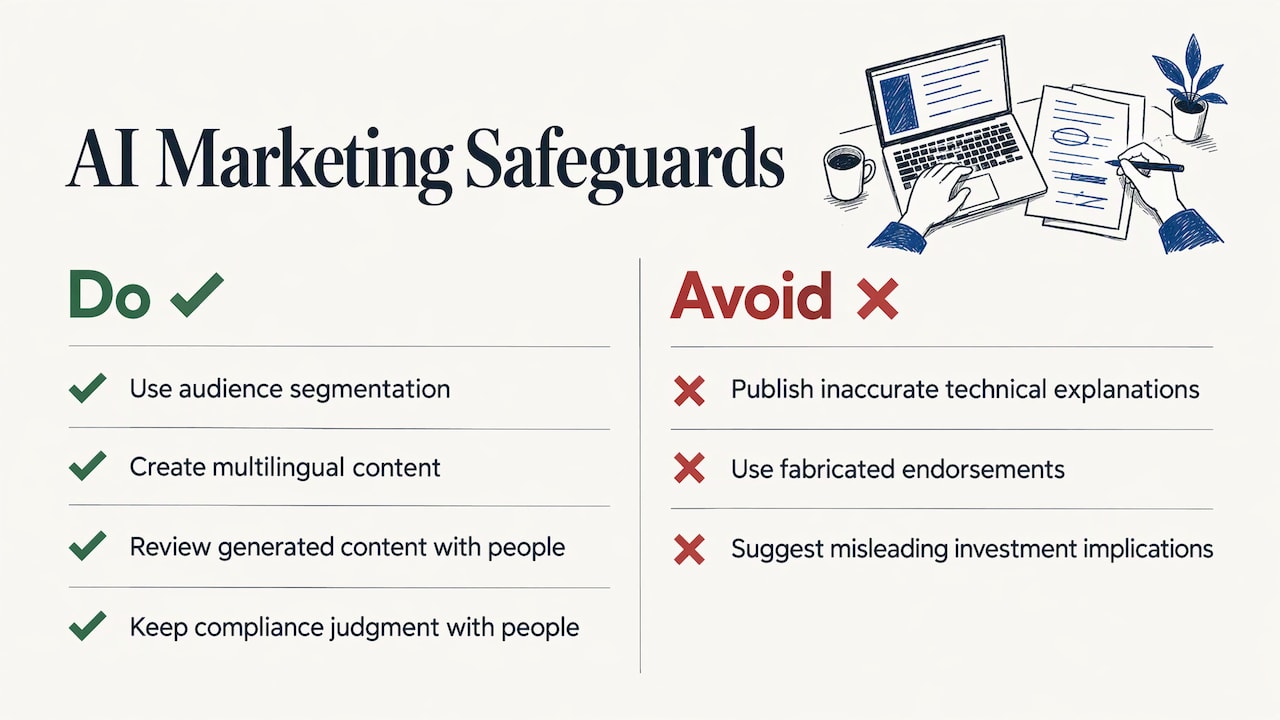
AI tools can help with audience segmentation, multilingual content, social listening and reading on-chain activity. The same research overview cautions that generated content can spread inaccurate technical explanations, fabricated endorsements and misleading investment implications. Its recommendation is human review, clear disclosure and keeping compliance judgment with people. Build that review step into any workflow, whoever runs it.
How to measure whether it is working
Impressions and follower counts are easy to report and say little about a blockchain product. Better questions:
- How many people actually use the product? Wallets connected, accounts created, transactions completed.
- How many come back? Retention after 30 and 90 days tells you more than launch-week spikes.
- How healthy is the community? Questions answered, members who help each other, share of conversation that is about the product rather than price.
- What does it cost to bring in one active user? Divide campaign spend by users who completed a real action.
- Are support issues falling? Fewer repeat questions suggest the education content is working.
Set these targets with your provider before the campaign starts and review them on a fixed schedule. Pairing them with a disciplined reporting setup, as in this look at analytics-driven marketing returns, helps teams see what to change. No provider can promise a particular outcome, and you should be wary of anyone who does.
How to choose a provider
Ask each candidate:
- Do you build, support and market, or only one of these?
- Which countries do you have experience marketing in, and how do you handle disclosure rules?
- How do you reach real users rather than short-term holders?
- Who answers user questions after launch, and how fast?
- What will you report each month, and what counts as success?
- Who reviews claims before they are published?
A single team covering development and growth removes most of the handoffs where things get lost.
Perspective
Most projects we meet do not fail because the code is bad. They fail because nobody can see them, or because the people who do show up find a product that is hard to use and a community that goes quiet.
That is why we do not treat marketing as a separate purchase. When the team that designs the wallet, exchange or token platform also runs community engagement and user acquisition, the message stays honest, because the people writing it know exactly what the product can do. Launch becomes the start of a relationship with users, not the end of a contract.
Our advice to founders is simple: plan the build and the growth together from the first week, write for a skeptical newcomer rather than an insider, and judge progress by people who use the product. We have delivered over 300 projects worldwide, and the pattern holds across token launches, fintech integrations and tokenization alike.
Alok
Work with Quest GLT
We handle end-to-end blockchain and Web3 product development together with community engagement and user acquisition, so one team carries your project from idea to active users. Our white-label products start from $3,000 one-off, and custom blockchain builds start from $25,000 one-off. Consulting, token development, exchange and wallet builds, tokenization and our crypto marketing work are scoped per project. Tell us about your project and we will outline what fits.

If you need extra engineering capacity for a product already in market, you can also hire blockchain developers from our team.
FAQ
How much do blockchain marketing services cost?
Costs depend on scope, countries and how long the engagement runs, so reputable providers quote per project or on a monthly retainer. At Quest GLT, our crypto marketing work is scoped to the project, and our published prices cover the build side: white-label products from $3,000 one-off and custom blockchain builds from $25,000 one-off.
What is the difference between blockchain marketing and Web3 marketing?
In everyday use the terms overlap. Both describe promoting blockchain-based products and building communities around them. Web3 often implies a wider set of products, such as NFTs, DeFi and decentralized apps, while blockchain marketing is used more for the underlying technology and token projects.
What does blockchain technical support include?
It covers monitoring and maintaining smart contracts, fixing bugs, shipping upgrades, handling security concerns and helping users who hit problems. It supports marketing because reliable onboarding and accurate release communication keep new users from leaving.
Do I need a lawyer before promoting a token?
Yes. Promotion rules depend on country and on whether the token may count as a security. A lawyer should review claims, influencer arrangements and target markets before launch, and we work alongside legal advisors on crypto projects.
How long before marketing shows results?
Community trust builds over months, not days. Agree on early indicators, such as active users and returning members, and review them on a regular schedule instead of waiting for a single launch-day number.
Sources
- Treiblmaier and Tan, cryptomarketing definition (Cogent Business & Management, 2026)
- Blockchain Marketing Service overview (360iResearch)
- How Blockchain Marketing Services Differ from Traditional Marketing (TechTimes)
- U.S. Crypto Influencer Promotions: FTC Disclosures, SEC Penalties
- Blockchain infrastructure basics (Utorg Learn)
- Why analytics in marketing drives better ROI