
A token presale platform is the system where a new token is configured, promoted and sold to early buyers before it trades on public exchanges. For a project, the real choice is whether to rent space on someone else’s sale page or to own the sale infrastructure: the contracts, buyer checks, vesting and dashboard. We build both custom and white-label presale platforms, and we also run the community and user growth around them, because a sale that closes into silence leaves the project with funds and no users.
This guide is for founders, fintech teams, asset owners and the lawyers who advise them. It explains the moving parts in plain words, what to require from a platform, and how a launch is sequenced.
TL;DR
- A presale platform handles the whole sale: project vetting, price and allocation settings, wallet connection, buyer checks, payment, and token release over time.
- The features that decide whether a sale is trusted are vesting enforced on-chain, buyer eligibility checks (KYC) and a published security audit.
- Legal setup comes first: the entity, the token design and the target countries need to be settled before any code goes live.
- Raising money is only half the job. Liquidity, delivery and community after the sale decide whether the token has real users.
- Our White-Label Products start from $3,000 one-off and Custom Blockchain Builds from $25,000 one-off, with growth support available alongside.
Table of Contents
- What a token presale platform actually does
- Presale or fair launch: pick by what the project needs
- The features to require from a presale platform
- How to launch your own token presale, step by step
- What happens after the presale ends
- Our view: own the sale, then build the audience
- Working with us on a presale platform
- FAQ
- Sources
What a token presale platform actually does
A presale platform, often called a crypto launchpad, is where new tokens are created, distributed and first sold before an exchange listing. It gives a project the venue, the sale mechanics and an initial audience that a brand-new token does not have, according to crypto.news.
In practice the pipeline looks like this:
- The project is reviewed on its team, token economics and market potential.
- The sale is configured: price, how many tokens are on offer, vesting, and minimum and maximum raise targets (often called soft and hard caps).
- The platform promotes the sale to its audience.
- Buyers connect a crypto wallet, pass identity checks where required, and buy at a discount to the expected listing price.
- After the sale, the listing is coordinated, liquidity is seeded, and purchased tokens unlock on a schedule.
That sequence is described in the same crypto.news explainer. Each step is a place where a sale can succeed or quietly fail, so the sections below take them in turn.
Presale or fair launch: pick by what the project needs
A presale gives early buyers a preferred price, usually with vesting. That funds the team, but it creates a structure with few tokens trading early and a high valuation, with selling pressure delayed rather than removed. A fair launch gives nobody a head start, but it turns into a speed contest where bots grab the cheapest tokens. crypto.news notes that the market has settled on fair launches for meme-style assets and on structured, vested sales for projects that need funded teams.
If you are building a product with a roadmap, payroll and audits to pay for, the structured presale is the model this article covers.
The features to require from a presale platform
Vesting that is enforced by the contract
Vesting means purchased tokens are released gradually instead of all at once. A “cliff” is an initial waiting period before anything unlocks, followed by a steady release. The strongest version is fixed on-chain at purchase. One published example is the nGRND token sale terms: part of a purchase may be released at launch, the rest follows a published cliff and linear schedule, buyers claim from their own wallet, and unvested tokens cannot be traded.
The same rule should apply to insiders. a16z crypto recommends that employees, investors, advisors and partners all follow the same vesting and lockup periods, since unclear or uneven lockups create mistrust and unpredictable behavior. A claim such as “team tokens locked for 24 months” should map to a mechanism in the contract, not to a promise. That is the point made in The Crypto Encounter’s launch guide.
A useful check for your own sale: compare how much value unlocks each day or month with the trading volume you expect. Large allocations unlocking into thin liquidity can push the price down hard.
Buyer eligibility and KYC
KYC (know your customer) means verifying who a buyer is. Platforms usually set a threshold. In the nGRND terms, buyers must be 18 or older, act for themselves, and meet jurisdiction and sanctions rules; KYC applies from a cumulative USD 1,000, enforced on-chain, with screening against sanctions, politically exposed person and adverse-media lists.
PwC’s token sale guide says each sale needs an appropriate KYC and anti-money-laundering framework so that people from prohibited jurisdictions cannot take part and criminal proceeds are not invested. Build these checks into the buying flow itself, so eligibility is decided before payment rather than cleaned up afterward.
Payment and wallet flow
The buying journey should be short: disclosures, eligibility check, terms, wallet connection, purchase, confirmation. Every extra screen costs buyers, and every missing disclosure costs you later. Test failed payments and failed token claims as carefully as the happy path.
A finished security audit
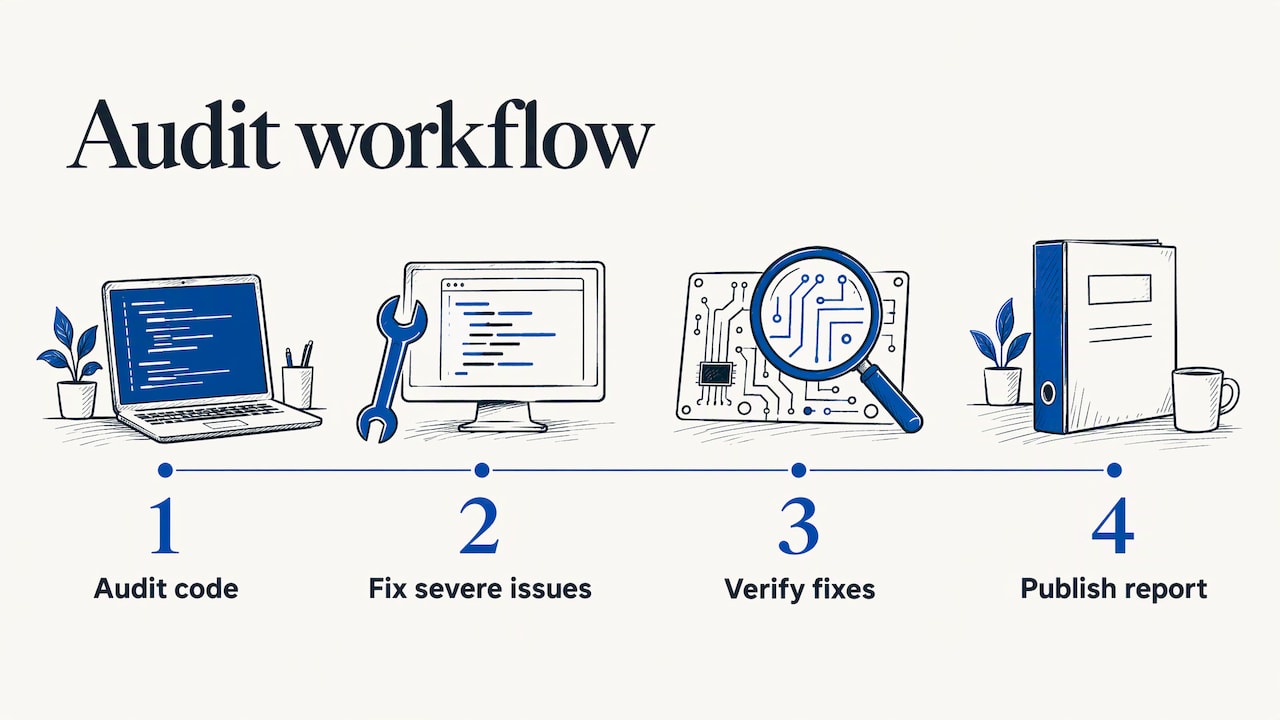
A presale contract holds buyers’ money, so the audit is not optional. a16z advises thorough code audits by qualified reviewers, fixing severe issues, verifying the fixes, and publishing the final report. Audit findings often center on missing vesting or lockups, which one audit report rates as a critical-severity issue.
Be realistic about what an audit means. The Blockchain Security Standards Council says no formal security guarantee is possible for a token; meeting its standard shows the token avoids a set of common, known weaknesses. That is why audits, testing and careful contract design all belong in the plan. Our smart contract auditing service covers this stage.
Contract functions that can change taxes, pause transfers, blacklist wallets, mint supply or move treasury funds should be disclosed, limited, and controlled through multisignature wallets or timelocks, as CryptoAdventure recommends. Buyers read these details, and so do the people who evaluate your project.
The sale page deserves a technical review too: broken redirects, missing pages or slow loading undermine trust before a buyer reaches the contract. Running pre-launch website checks on the sale site catches many of these problems.
How to launch your own token presale, step by step
The sequence below follows PwC’s professional guidance and the 90-day plan in The Crypto Encounter’s guide. It is a framework, not legal advice.
Step 1: Set up the legal foundation
PwC’s sequence starts with the token’s utility and economic model, then the sale timeline, legal, regulatory and tax advisors, a legal entity, drafted sale documents and finished KYC and AML processes, all before launch. PwC also stresses that governance, including token-holder rights, use of proceeds and decision-making, has to be designed before the sale, not after.
Where you may sell is a legal question. A jurisdiction matrix, sorting countries into approved, conditional, restricted and unresolved, is a practical tool, and a project that bans a country while paying promoters to reach buyers there has not solved the problem. If you are a lawyer advising a crypto client, this is the stage where you need the product team and the counsel in the same room.
Several rules differ by country, so treat each as local:
- United States: whether a token is a security is a case-by-case analysis. A legal checklist from Astraea Law estimates ongoing compliance costs after an offering at $50,000 to $200,000 a year, depending on size, and lists reporting duties if Regulation A+ is used.
- European Union: under MiCA, retail buyers get a 14-day withdrawal right for most crypto-assets bought directly from the offeror. It cannot be used after a time-limited offer ends, and it does not apply to assets already admitted to trading.
- Canada: an Ontario tribunal decision in September 2026 found that tokens representing fractional interests in collectibles were investment contracts and therefore securities, distributed without a prospectus.
A token sold to accredited investors before the network works is often structured as a SAFT, a simple agreement for future tokens, which Cooley’s framework treats as a security itself. Your securities lawyer decides which structure fits.
Step 2: Design the token economics
Tokenomics is the plan for supply, who receives what, when it unlocks, and what gives the token demand. Treat it as a system connecting supply, demand, incentives, vesting, product behavior, treasury and governance, not as a pie chart. If you are unsure how a token differs from a coin before you design one, our short explainer on the difference between coins and tokens helps, and our guide to token development scope, costs and choosing a provider covers the build side.
At this step we take the engineering off your hands: our team handles cryptocurrency token development so the supply, vesting and allocation you decide on become contract code.
Step 3: Build the sale infrastructure
This covers the sale contract, the buyer dashboard, wallet connection, KYC integration and the admin panel you use to run the sale. Two routes exist for a project that wants its own platform. A white-label product is a ready-made platform that we customize to your brand, and a custom build is designed around your sale rules from scratch. White-label suits a team that needs to move quickly with standard mechanics. A custom build suits a sale with unusual vesting, multiple rounds or integrations with your product.
Step 4: Test and verify
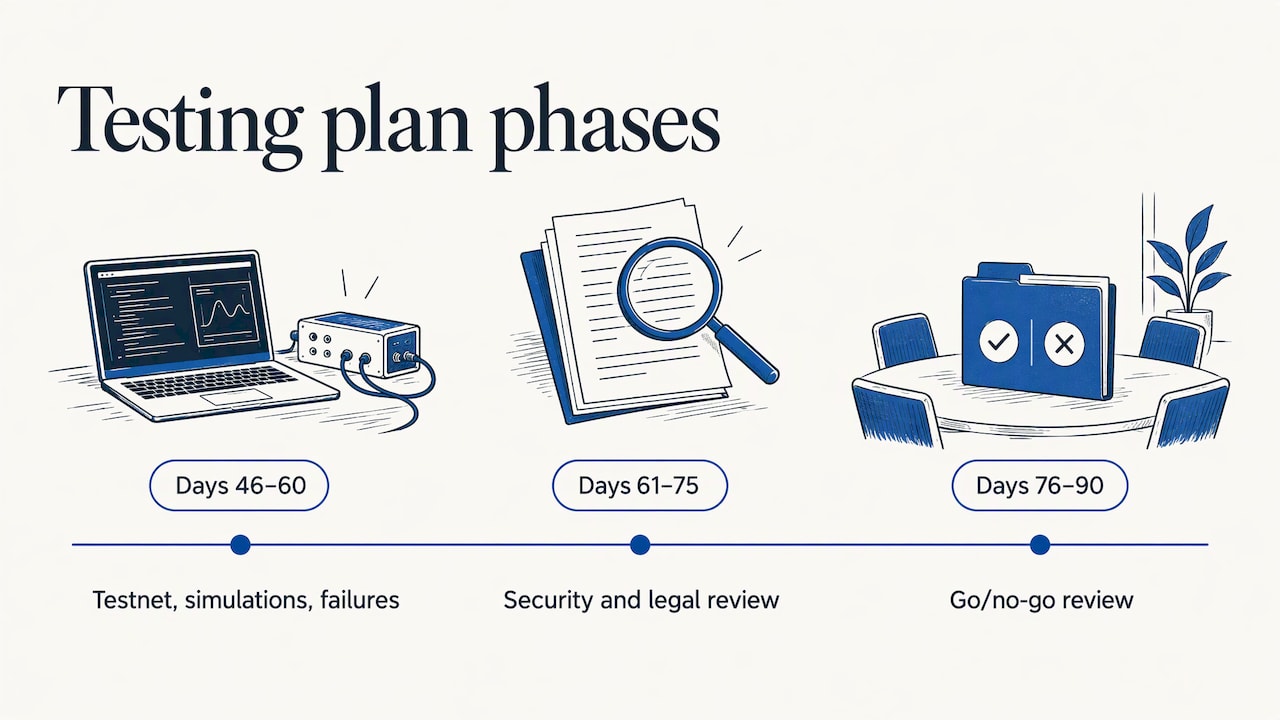
The 90-day plan puts testing at days 46 to 60: testnet deployment, purchase simulations and failure states. Security review and legal verification follow at days 61 to 75, and a go or no-go review closes the plan at days 76 to 90. a16z also advises sending test transactions and confirming receipt before distributing any tokens.
Timelines vary with the chain. a16z notes that high-quality custody providers can take six to nine months or longer to support a new Layer 1 blockchain, against roughly three to five months for standard ERC-20 or Solana tokens. If you want listings and custody in place, choose the chain early.
Step 5: Launch, deliver and support
A token generation event (TGE) is the moment tokens are created and the first ones are released. Plan a runbook for before, during and after it, including checks that distribution totals and vesting match the published numbers and a process to resolve failed claims.
What happens after the presale ends
The raise is the midpoint. After it, buyers expect delivery, a listing and news. Liquidity is where many presales falter: a project that raises millions but opens with a small liquidity pool creates a dangerous mismatch, and a vague promise of an exchange listing is not a listing until the exchange confirms it.
Compliance continues as well. Depending on the structure, that can mean periodic reporting, transfer restrictions enforced in the smart contract and ongoing sanctions screening, as Astraea Law’s checklist explains for U.S. offerings.
This is the gap we built our offer around. Many technology providers hand over the code and leave. We also run community engagement and user acquisition campaigns after launch, so the people who bought in have a reason to stay. You can see how we document client work in our IBVM case study.
Our view: own the sale, then build the audience
Why we build presale platforms and the growth around them
Most presale pages we are asked to review focus on the raise: the cap, the price, the countdown. Founders spend little time on what a buyer sees six months later. Did the tokens arrive on the published schedule? Is there a community that talks about the product rather than the price?
That is why we pair engineering with growth. We build custom and white-label blockchain platforms, and we run the community and user acquisition work that follows. Across more than 300 projects delivered globally, the pattern we aim to prevent is a project that launches and is then left without support.
Our advice: keep vesting in the contract, put eligibility checks in the buying flow, get the audit done and published, and plan the post-sale months before the sale opens. We cannot promise any sale result, since markets decide that. We can make sure the technology and the plan around it are sound.
Alok
Working with us on a presale platform
We offer White-Label Products from $3,000 one-off and Custom Blockchain Builds from $25,000 one-off. Related services include token development, smart contract and blockchain security audits, crypto marketing and compliance-minded delivery for fintech and crypto businesses. Pricing for those is agreed per project. To discuss your sale, start at Quest GLT.

FAQ
What is a token presale platform?
It is the system that runs the sale of a token before public trading: sale settings, wallet connection, buyer checks, payment and scheduled token release. Some platforms are shared launchpads with their own audience, while others are built for a single project.
How can I launch my own token?
Settle the legal entity and target countries, design the token economics, build and test the sale contracts and buyer flow, complete a security audit, and then run a launch plan covering distribution and liquidity. The step-by-step section above follows this order.
What happens after a presale?
Tokens are delivered according to the vesting schedule, liquidity is seeded and a listing is coordinated. Compliance duties and communication with buyers continue. A small liquidity pool or an unconfirmed listing can undermine an otherwise successful raise.
Do all buyers need KYC?
That depends on the sale’s rules and the law of the countries involved. Some platforms apply KYC above a set purchase total, such as USD 1,000 in one published example, while others require it for everyone. Your legal counsel should set the rule for your sale.
Sources
- What is a crypto launchpad? Fair launches explained (crypto.news)
- Terms of Token Sale, nGRND ICO
- Operational guidelines for token launches (a16z crypto)
- How to Launch a Crypto Presale Project: Full Guide
- Crypto Presale Research Guide
- Introduction to Token Sales (ICO) Best Practices (PwC)
- ALTDeer audit report
- BSSC Token Integration Standard, version 2
- Token Launch Legal Checklist (Astraea Law)
- MiCA, Regulation 2023/1114 (EUR-Lex)
- Ontario Securities Commission v. Liquid Marketplace Inc. decision
- The SAFT Project (Cooley)
- Pre-launch QA