A decentralized autonomous organization, or DAO, is a group that is owned and run by its members through rules written into software on a blockchain, instead of being run by a single manager or board. Members propose changes, vote on them, and the software carries out the result. For a startup, a fintech team or an asset owner, a DAO is a way to share ownership and decisions with a community and make every step visible. It works best when the technology, the legal setup and the community are planned together. That joined-up approach is what we build at Quest Global Technologies.
TL;DR
- A DAO is a collectively owned organization whose rules live in smart contracts (programs on a blockchain) rather than in one leader’s hands.
- Members usually hold tokens that let them propose and vote. When a vote passes, the code can release funds or apply the change automatically.
- Common uses include funding grants, pooling capital for investments, running protocols and managing shared assets.
- The main design questions are who really holds voting power, how bugs get fixed, and what legal form the DAO takes in your country.
- Technology, token design, legal structure and community growth all need to be planned before launch, not after.
Table of Contents
- What a DAO is, in plain words
- DAO vs. a traditional organization
- How a DAO works, step by step
- What DAOs are used for
- Benefits worth planning for
- Design questions every DAO has to answer
- The legal side: wrappers and jurisdictions
- Building a DAO: a practical sequence
- Our perspective
- Work with Quest GLT on your DAO or token project
- FAQ
- Sources
What a DAO is, in plain words
Break the name into three parts.
Decentralized means no single person or company holds all the authority. Control is spread across many participants and many computers.
Autonomous means that rules run themselves. Once the rules are written as code, the software enforces them without someone clicking “approve” each time.
Organization means people are coordinating toward a shared goal, such as funding projects, owning an asset or governing a protocol.
Ethereum’s own documentation describes a DAO as a collectively owned organization working toward a shared mission, governed by blockchain-based rules rather than a single leader. The World Economic Forum describes DAOs in similar terms: communities that propose, vote on and implement changes to coordinate resources and pursue shared goals, often without hierarchical management.
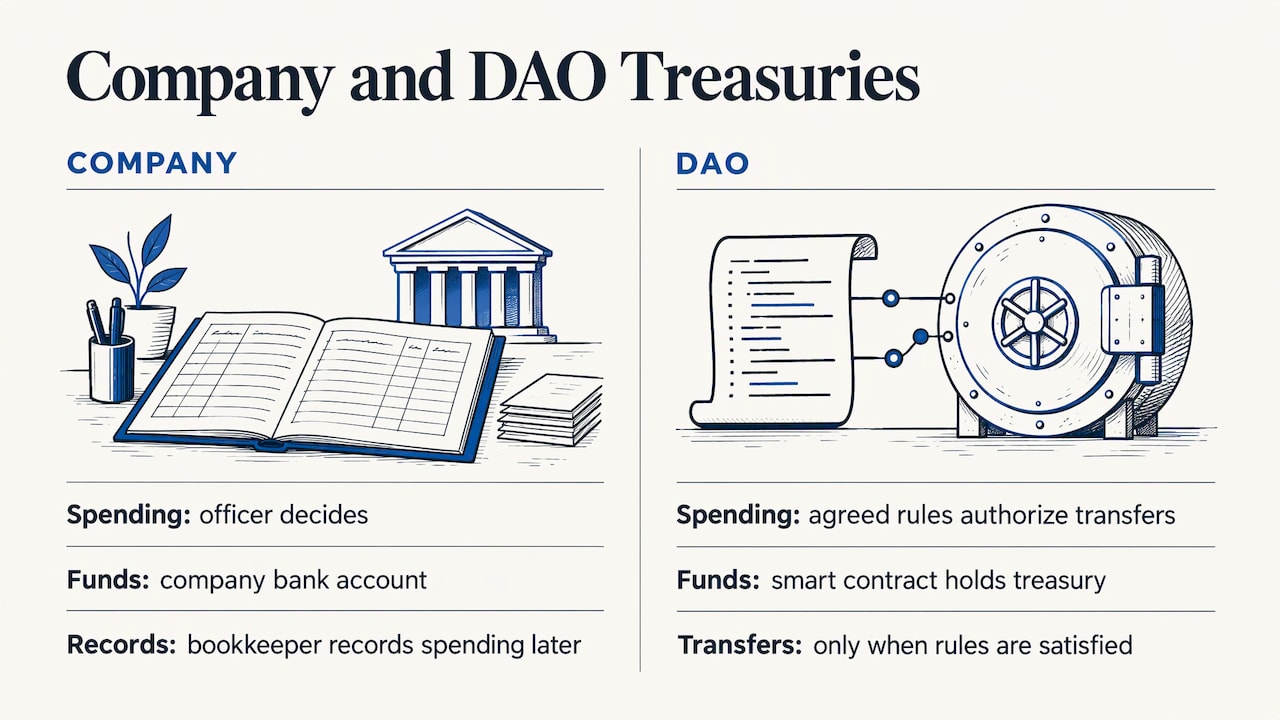
A useful comparison is a company bank account. In a traditional company, an officer decides to spend money and a bookkeeper records it later. In a DAO, the treasury (the shared pool of funds) is held by a smart contract, and money moves only when the agreed rules are satisfied.
DAO vs. a traditional organization
Ethereum.org contrasts the two models on a few points. Traditional organizations are usually hierarchical, implement decisions by hand and keep most activity private. DAOs are generally flat, let members vote, automate the result and keep their activity public.
| Feature | Traditional company | DAO |
|---|---|---|
| Who decides | Executives and a board | Members, through proposals and votes |
| How decisions are carried out | By staff, manually | By smart contracts, automatically when rules are met |
| Who can see the activity | Mostly insiders | Anyone, because records sit on a public blockchain |
| Who can join | Hired or approved people | Often anyone who holds the membership token |
| Legal form | Corporation, LLC, partnership | Depends on the country and the chosen structure |
The table shows why founders are interested. A DAO can bring a global community into ownership and decision-making without building a conventional management layer first.
How a DAO works, step by step
Most DAOs follow the same basic loop.
1. Rules are written as smart contracts
A smart contract is a small program stored on a blockchain that runs exactly as written. According to Ethereum.org, a DAO’s smart contracts set the organization’s rules and hold its treasury. After deployment, changing those rules requires a vote, and any transaction that breaks the code-defined rules fails.
The European Central Bank describes the same idea from a financial regulator’s side: DAOs typically encode protocols agreed by participants on a blockchain and run them through smart contracts, which can include pooling resources and managing projects.
2. Members receive voting power
Voting power usually comes from a token. Holding more tokens often means more votes, though some DAOs use other schemes. Token design is one of the most important early choices, because it decides who can steer the organization.
3. Someone makes a proposal
A proposal might ask to fund a grant, change a fee or hire a contributor. A paper in the Journal of Institutional Economics notes that token holders may propose and vote on how the treasury is used, and that on-chain governance records proposals and votes on the blockchain itself.
4. Members vote
Decisions generally run through proposals and voting, and payments can be authorized automatically when a vote passes. Each DAO sets its own rules for how long voting lasts and how many votes are needed.
5. The code executes the result
If the vote passes, the contract does the work. Funds move, a setting changes or a new member is added. Because every step is recorded on the blockchain, anyone can check what happened.
What DAOs are used for
Ethereum.org lists several uses: charity funding, shared ownership of physical or digital assets, and ventures or grants. Real examples show the range. A 2024 MITRE report on the digital-asset ecosystem describes several types of DAOs:
- Protocol governance. MakerDAO lets holders of its MKR token vote on system settings, while smart contracts manage the issuance and stability of its DAI coin, according to MITRE’s 2024 report.
- Grants. The same report names Gitcoin as a grants DAO.
- Investment. BitDAO is listed as an investment DAO.
- Collecting. PleasrDAO is a collector DAO.
- Impact. KlimaDAO is an impact DAO.
- Media. Bankless is a media DAO.
For the readers of this article, the practical use cases tend to be these:
- Token launches. A startup hands governance of a protocol or treasury to its token holders over time.
- Fintech. A lending or payments product lets users vote on fees, risk settings or new features.
- Tokenized assets. Owners of a tokenized property or fund use a DAO-style vote for shared decisions such as maintenance, sale or distribution.
- Communities. A product community pools funds to reward contributors.
Benefits worth planning for
The European Central Bank’s paper lists several potential benefits: lower barriers to entry, faster and cheaper voting, quick pooling and deployment of capital, flexibility, transparency and cooperation on innovation. A primer from the Harvard Law School Forum on Corporate Governance adds direct member control, reduced overhead, global participation and automatic execution of properly programmed rules.
In practice, the benefits that matter most to a funded team are:
- Aligned incentives. People who hold a stake in the outcome have a reason to help the product grow.
- Transparency. Investors, users and regulators can see how money moves.
- Reach. Anyone in the world can take part without opening a local entity.
Design questions every DAO has to answer
A good DAO is designed around a few known pressure points. Research on these points shows what to plan for.
Who actually holds the votes? A 2023 American Economic Association paper analyzed 10,639 proposals across 151 DAOs and found that a small number of entities, often three or fewer, controlled most decisions. Token distribution, vote caps and delegation rules help keep influence spread out, so they belong in the design from day one.
How do you keep members engaged? The ECB notes that a large volume of proposals can cause voter fatigue. MITRE points to low turnout and limited voter expertise. A DAO needs a clear proposal process and an active community, which is why growth work and governance design go hand in hand.
How do you handle bugs and surprises? Code runs exactly as written, so the ECB observes that rigid execution can make it hard to adapt to bugs or unforeseen events. This is why contract design, testing and security review come before launch.
How exposed is the treasury? MITRE flags smart-contract weaknesses and treasuries that rise and fall with token prices. The Harvard primer also lists coding defects and cyberattacks. Treasury rules, spending limits and independent security checks are the standard answers.
What is the legal form? This is the question lawyers and founders ask most, and it gets its own section below.
The legal side: wrappers and jurisdictions
Law has not caught up with DAOs in most places. The ECB says that in many jurisdictions there is no DAO-specific legal regime, so a DAO’s legal character depends on its structure, national law and possibly court decisions. The Law Commission of England and Wales adds that decentralization is not defined in law and has no single agreed meaning or test.
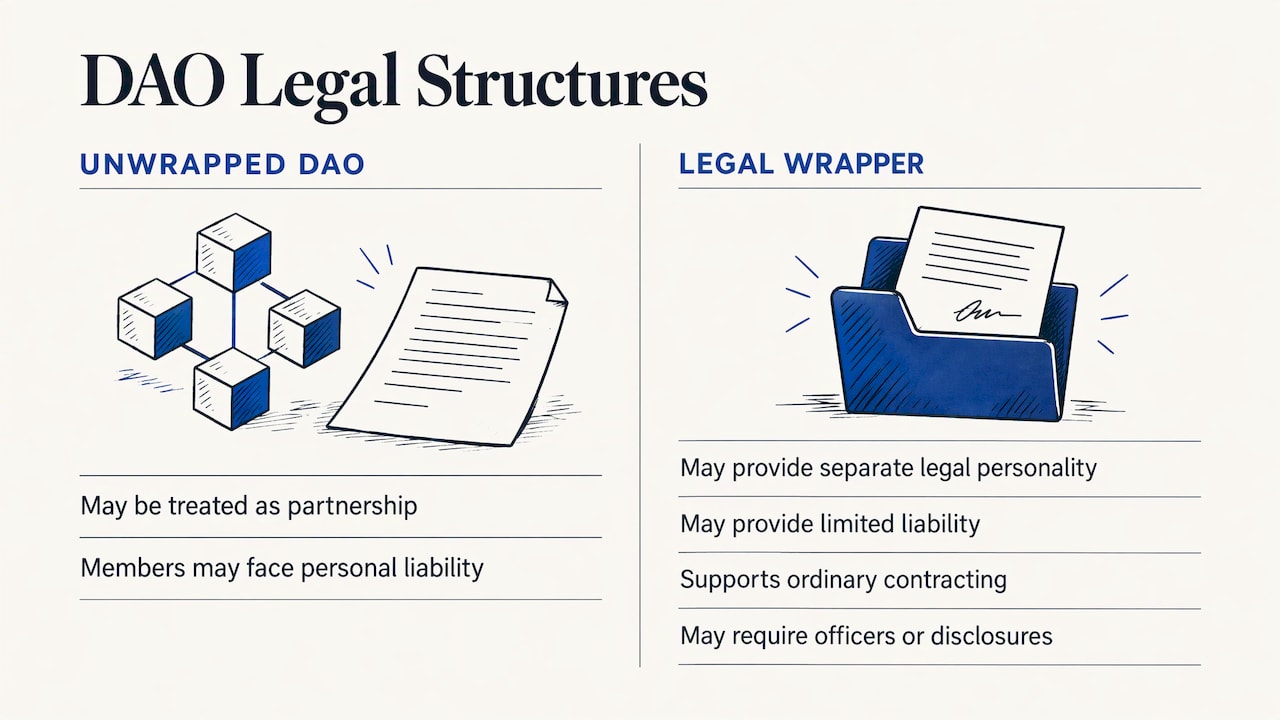
For US readers, the Harvard primer explains the key risk: an unwrapped DAO may be treated as a general partnership in some circumstances, which could create personal liability for members. Legal structures such as LLCs or foundations can act as a bridge to ordinary contracting, such as signing agreements or opening bank accounts.
A “legal wrapper” is a conventional entity placed around the DAO. The Law Commission notes that wrappers may give a DAO separate legal personality and limited liability, but can require named officers or disclosures that trade off against decentralization and anonymity. Rules also differ between countries. The ECB says that in the EU, a DAO providing crypto-asset services within the scope of the MiCA regulation may need authorization and legal personality. Choosing an entity type is always local, and seeing how company types compare in Brazil shows how much the options vary from one country to the next.
If you are a lawyer advising a crypto client, or a founder choosing where to set up, speak with a qualified attorney in the relevant jurisdiction before launch. Securities, licensing and tax rules can apply to token sales and treasury activity, and the choice of structure should be made together with the technical design.
Building a DAO: a practical sequence
This is the order we suggest when a team plans a DAO.
- Define the mission and the decisions members will make. A DAO that votes on everything tires its members. Start with a short list of decisions that really belong to the community.
- Design the token and the voting rules. Decide who receives tokens, how they unlock, whether votes can be delegated and whether any cap prevents one holder from dominating.
- Choose the legal structure with your counsel. Match the wrapper to where your team, your users and your assets sit.
- Build and test the smart contracts. Cover voting, treasury and upgrade paths. Plan for how the DAO responds to a bug.
- Get an independent security audit. An outside review of the code before launch lowers the chance of avoidable flaws.
- Launch with a real community. Governance only works when people show up to vote. Plan onboarding, education and incentives before the token goes live.
- Review and adjust. Track turnout and how concentrated the voting is, and refine the rules through proposals.
If you want to understand the building blocks, our guides on how data is written to a blockchain and building a blockchain application from scratch cover the foundations in plain language.
Our perspective
Most DAOs that struggle do not fail because the idea was wrong. They struggle because the technology was built and then the team walked away from the people who were supposed to use it.
A DAO is two products at once: a set of smart contracts and a community that has to care enough to vote. If either is missing, you have an empty treasury contract or a chat group with no way to act. That is why we treat the build and the growth work as one job. Our positioning is simple: we engineer the technology and the means to reach real users, so clients are not left alone after launch.
We have delivered over 300 projects worldwide, including token creation and launch, DeFi platforms, exchanges, wallets and real-world asset tokenization. In each of them the same questions come up early: who gets voting power, how the treasury is protected, and what legal form fits. We recommend answering them together with counsel before a single line of code is final.
Keep the language simple and the first version small. A focused DAO with a few clear decisions and an engaged community is easier to run than a grand design nobody understands.
Alok
Work with Quest GLT on your DAO or token project
If you are launching a token, adding blockchain to a fintech product or tokenizing assets, governance is part of the product. We build custom blockchain solutions, from $25,000 one-off for custom builds, and white-label products from $3,000 one-off. Our services also include token development, DeFi development, dApp development, blockchain security audits, real-world asset tokenization and crypto marketing for community growth. Many clients start with blockchain consulting to scope the governance model before any build begins.

See the full list of services on the Quest GLT site, or look at our dApp development and real-world asset tokenization pages if your project is already taking shape.
FAQ
What does DAO stand for?
DAO stands for decentralized autonomous organization. It is a group whose rules are written in code on a blockchain and whose members make decisions together by voting, rather than following one central leader.
What does “decentralized” mean in simple terms?
It means that control is shared among many participants instead of sitting with one person or company. In a DAO, the members who hold voting tokens decide together, and the blockchain keeps a public record of what was decided.
What are some examples of DAOs?
MakerDAO governs the system behind the DAI coin through votes by MKR holders. Gitcoin is described as a grants DAO, and BitDAO as an investment DAO. Others focus on collecting digital art, funding climate projects or publishing media, according to MITRE’s 2024 report.
Is a DAO legal in the United States?
There is no single DAO law that covers every case. A DAO with no legal entity may be treated as a general partnership, which can expose members to personal liability, according to the Harvard Law School Forum primer. Many teams use an LLC or a foundation as a wrapper, and should choose it with a qualified attorney.
Is a DAO truly run by everyone?
It can be, but only if the rules are designed for it. Research on 151 DAOs found that a few holders often controlled most decisions, so token distribution and voting rules matter from the start.
Sources
- What is a DAO? (Ethereum.org)
- The future of DAOs in finance: in need of legal status (European Central Bank, Occasional Paper No. 331)
- Decentralized Autonomous Organizations: Beyond the Hype (World Economic Forum)
- The nature of the decentralised autonomous organisation (Journal of Institutional Economics)
- Systemic Risk in the Digital Assets Ecosystem (MITRE, 2024)
- Control of Decentralized Autonomous Organizations (American Economic Association)
- A Primer on DAOs (Harvard Law School Forum on Corporate Governance)
- Decentralised autonomous organisations: a scoping paper (Law Commission of England and Wales)